Multifunctional Observation Tower Titz-Jackerath – A Catalyst Project for the Garzweiler Structural Transformation
The Titz-Jackerath observation tower forms an early and highly visible component in the transformation process of the Garzweiler mining region. As a catalyst project of the LANDFOLGE Garzweiler special-purpose association, it marks the transition from an industrial landscape to a new, ecologically oriented living environment. With its consistently circular construction method, modular usage concept, and integration into a climate-resilient open space system, the tower sets a benchmark for sustainable building, regional identity, and confidence in the future. It becomes a place that makes change tangible – as a landmark, a space for learning and interaction, and a starting point for a landscape that will fundamentally reshape itself over the coming decades.
Name
Multifunctional Observation Tower in Titz-Jackerath
Partner
Zweering Helmus Architekten Part GmbB
Award
1st Prize
Services
Open Space Planning, Landscape Design
Location
Titz-Jackerath, Germany
A Catalyst Project in Transition – Site, Context, and Objectives
The observation tower is located at a site that symbolically represents the transformation of the Rhenish mining area: at the edge of the former Garzweiler open-cast lignite mine, directly adjacent to the dismantled A61 highway and in immediate proximity to the future lake landscape. From 2036 onward, groundwater will begin to fill the new Garzweiler Lake, which is expected to develop into a body of water covering approximately 2,200 hectares by 2066. Initial shoreline areas are scheduled for development as early as the 2040s.
The tower marks an early structural starting point – a signal structure that anticipates the future lakeside promenade while demonstrating how resource-efficient, future-ready construction can succeed in the context of structural transformation. As part of the “Blue-Green Belt Garzweiler,” the project sees itself as a contribution to the “Excellence Region for Sustainable Building” and sets standards for climate-conscious building culture.
Circular Construction as an Architectural Leitmotif
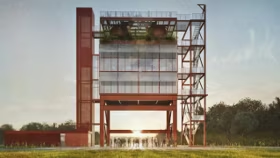
The construction of the observation tower is consistently based on reuse. Steel frameworks and carport modules from the decommissioned Frimmersdorf power plant are dismantled, transported, and reassembled in adapted form.
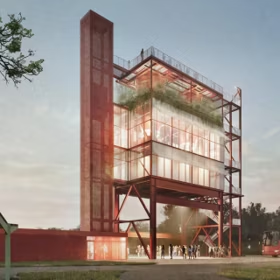
On a footprint of 8 × 15 meters, six levels are created, whose industrial origin remains deliberately visible and becomes part of the architectural narrative.
Additional components made of local and renewable materials are integrated into the existing loadbearing structure. The design follows a target value catalog for resource-circular, climate-friendly, and cost-optimized construction developed in collaboration with Werner Sobek Green Technologies. In this way, the tower becomes a prototype for forward-looking material cycles.
Integration into a Transforming Landscape
The positioning of the tower is not based on the current context but on the future development of the landscape. It forms the first fixed point of a new open space structure consisting of terraces, pathways, and places to stay.
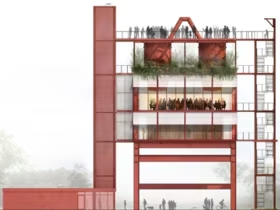
The lower levels remain open as a continuous public passage and act as a “gateway to the future,” guiding visitors from the village of Jackerath toward the emerging lakeside landscape.
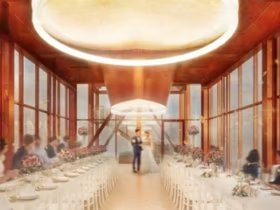
The upper floors accommodate ancillary spaces and a multifunctional event space that showcases the distinctive lime silos of the original structure.
An intensively planted level with preserved industrial elements symbolizes the connection between dismantling and renaturation.
The top platform offers expansive views over the future waterscape, making the transformation spatially tangible. A fire protection–upgraded stair tower and a barrier-free elevator in the adjoining pavilion ensure access to all levels.
Use, Design, and Spatial Flexibility
The tower is conceived as a modular high-bay structure that can be flexibly adapted to different uses.
Enclosed areas are fitted with transparent installations that keep the red steel structure visible.
Post-and-beam facades with a high proportion of glazing and textile sun protection create openness and lightness.
Interior spaces such as the large multifunctional room with a mobile kitchenette can be used in a variety of ways and are suitable for school classes, exhibitions, events, or educational programs related to structural transformation.
The observation tower is intended as a public place – accessible, adaptable, and identity-forming.
Open Space Concept – Entrance, Mobility, and Landscape
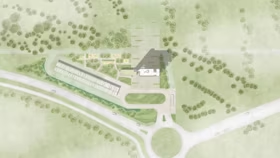
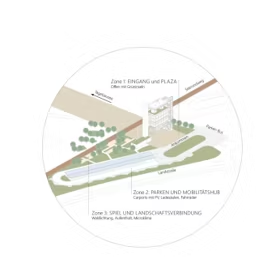
The design of the surroundings integrates the tower into a three-part open space system that combines ecological performance with high-quality public use.
The entrance area opens as a plaza with species-rich meadows, seating options, shade elements, and high-quality surfaces complemented by shell limestone gravel from regional geology.
To the east, a mobility hub is created with 48 parking spaces, bicycle facilities, and reused carports from Frimmersdorf that are converted into solar roofs. Rainwater is collected in swales and retention areas, where it infiltrates the ground, reducing flood risks and strengthening groundwater reserves.
North of the tower, a new plaza connects the viewpoint with a near-natural forest clearing offering play facilities for various age groups.
Timber structures, barrier-free elements, and a potential calisthenics extension create a robust and vibrant space with strong ecological impact.
Species-rich meadows, native tree species, and green roofs extend biodiversity vertically and connect the tower with its surroundings.
A Structure as a Symbol of Transformation
The Titz-Jackerath observation tower represents the profound transformation of the Garzweiler region. It unites industrial heritage, ecological future, and a building culture based on reuse, resource conservation, and social openness. As a landmark, learning space, and meeting point, it forms an identity-defining starting point for the emerging landscape of Lake Garzweiler – demonstrating how transformation can be shaped with courage, clarity, and sustainability.
Image credits
Site plan: ensphere GmbH
Perspectives, sections, pictograms: Zweering Helmus Architekten Part GmbB