Three Squares, One Center – The Open Space Concept for Verden’s City Center
The landscape design concept for the three central squares in Verden’s city center – Lugensteinplatz, Anita-Augspurg-Platz, and Domplatz – develops the historic core into a coherent, distinctive, and climate-adapted urban space. It connects the individual history and atmosphere of each square through a shared design leitmotif and creates places to stay that are functionally, ecologically, and culturally compelling. At its core are the sensitive development of the existing fabric, the strengthening of public space, and a sustainable approach to water, climate, and biodiversity.
Name
Redesign of Domplatz, Lugenstein, and Anita-Augspurg-Platz in Verden
Partner
Kortemeier Brokmann GmbH
Services
Open space planning, landscape design
Location
Verden, Germany
An Urban Fabric in Transition
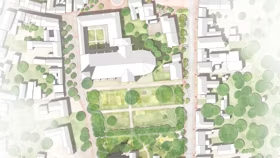
The three closely interwoven squares form a historic and social center of particular significance. They serve as arrival points, places to linger, and meeting spaces – as locations for commerce as well as remembrance culture and leisure. The concept aims to shape this ensemble as a coherent urban space without losing the distinctive character of each square. It is based on an overarching design principle that combines spatial connectivity, the circle motif, climate-adapted solutions, and the promotion of biodiversity. The result is a robust, contemporary urban space that responds to the challenges of climate change while honoring Verden’s history.
Lugensteinplatz - Gateway, Market Square, and Connecting Element
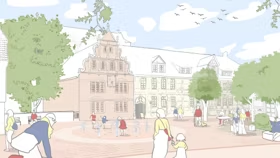
As the northern gateway to the old town, Lugensteinplatz mediates between the cathedral and the pedestrian zone. Its central design element is the newly interpreted circular pattern in the paving, which organizes the square and emphasizes its special role as a place of arrival.
A large-format paving circle marks the access to the cathedral and is complemented by inlaid inscriptions that highlight historical figures and events. Grass joint paving enables partial unsealing, improved infiltration, and reduced heat generation without restricting its use as a market square.
The valuable existing trees are preserved and supplemented with climate-resilient species that enhance the microclimate through shading and evapotranspiration.
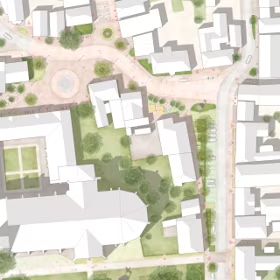
New green-framed seating areas invite people to stay. The local landmark “Mückenschiss” also gains a stronger presence as a meeting point through its placement on a planted plinth. Water takes on a new role: multifunctional fountains provide cooling and invite playful interaction, yet can be deactivated during events. The traffic-calmed character is reinforced by a uniform paving design, while outdoor dining and bicycle parking continue to fulfill important functions.
Anita Augspurg-Platz – A Space of Democratic History
Located east of the cathedral, Anita-Augspurg-Platz connects Lugensteinplatz and Domplatz and functions as an urban hinge.
A reorganization of the street layout creates a generous, barrier-free square that strengthens the internal pedestrian ring between the three squares. The materiality of Lugensteinplatz continues here, creating a harmonious overall appearance.
Greened parking spaces, rows of trees, and grass joint paving improve the microclimate and infiltration capacity, creating a pleasantly shaded environment.
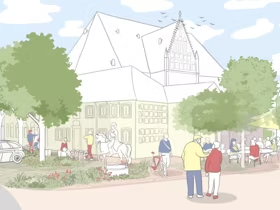
A new equestrian monument honors Anita Augspurg – jurist, women’s rights activist, and a significant voice of the democratic movement. Access is staged by a structured “green ribbon” that creates small places to linger, seating areas, and bicycle parking. This is complemented by history stones with QR codes that communicate historical content digitally, transforming the square into a place of remembrance and civic education.
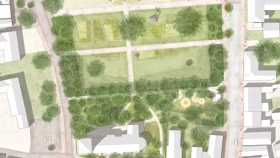
Domplatz – Historic Setting an Multifaceted Urban Space
South of the cathedral, Domplatz opens up as a generous square of high historical significance. The redesign is carried out with care in order to preserve the authenticity of the site. At the same time, targeted additions create new spatial qualities and ecological value. Reinforced grass replaces parts of the gravel surface, increasing both infiltration capacity and green coverage. Two existing lawns are transformed into diverse flowering meadows that recall historic monastery gardens and provide valuable habitats for insects. Accessible via grass paths, they become quiet places of relaxation.
The southern area remains an active lawn for events but receives subtle topographical modeling that creates new places to stay and visual connections to the cathedral. Beneath St. Andrew’s Church, light perennial plantings ensure greater transparency, biodiversity, and seasonal structure. The playground in the southwest is expanded into an intergenerational space for movement and encounter that combines play equipment, fitness facilities, and barrier-free seating following the circular design motif.
A Future-Proof Urban Space – Water, Climate, and Biodiversity in Focus
The redesign creates a coherent urban space that combines historical significance, design quality, and ecological resilience. The characteristic brick paving remains the guiding material but is differentiated according to use. The City of Verden continues its strategy of climate-adapted urban development: unsealing, permeable surfaces, and reinforced grass improve water management, reduce heat, and create a pleasant microclimate. Water fountains provide cooling and enhance the quality of stay.
At the same time, the concept strengthens biodiversity through climate-resilient tree species, species-rich planting areas, and ecological connectivity. The result is a distinctive, intergenerational, and sustainable urban structure that preserves Verden’s historic core while preparing it for future challenges.
Image credits
Site plans: ensphere GmbH
Perspectives: Kortenmeier Brokmann