Lifeline City Center Kleve – A Climate-Resilient Pedestrian Zone For The Future
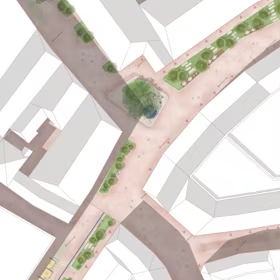
The redesign of Kleve’s pedestrian zone transforms the central urban space between Minoritenstraße, Herzogstraße, and Fischmarkt with the Elsa Fountain into a climate-adapted, identity-forming, and economically resilient lifeline of the city center. The concept responds to the urban context, the significance of the State Garden Show 2029, and the complex topography of the gently sloping Große Straße. It brings together retail, history, everyday life, and festive culture, creates new green places to stay, and applies sponge city principles to actively integrate water and climate into the design. The result is a vibrant, future-ready backbone for the city center that preserves Kleve’s historic identity while preparing it for the challenges of the decades ahead.
Name
Redesign Of The Pedestrian Zone In Kleve
Services
Open Space Planning, Landscape Design
Location
Kleve, Germany
Core Idea and Urban Design Guidelines
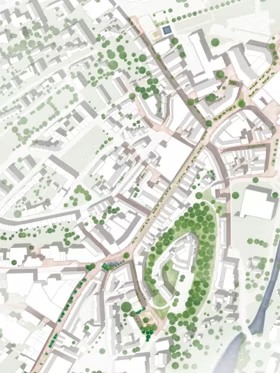
At the heart of the design lies the idea of the pedestrian zone as a “lifeline” – a continuous, adaptive system running through the city center.
It connects economic functions with Kleve’s cultural roots and strengthens references to the Schwanenburg as well as the Baroque garden and visual axis tradition.
The design reinterprets these historic lines in a contemporary spatial structure with clear sightlines and distinctive spatial edges.
Paving, street furniture, and lighting create a robust, context-sensitive identity, while modular construction methods and economically phased implementation ensure feasibility and minimize disruption to retail.
Climate Resilience And Sponge City Principles
A central objective of the concept is the development of a climate-resilient city center capable of addressing heat, heavy rainfall, and dry periods alike.
The design consistently follows sponge city logic: unsealed areas with water-bound surfaces, clinker, and open-jointed natural stone allow infiltration and cooling.
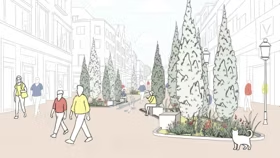
Decentralized rainwater management is achieved through bioswales, water islands, retention modules, and linear channels with sediment traps. This is complemented by a targeted tree-planting strategy that provides small to medium-sized canopies in narrow sections and establishes large, expansive tree species in widened plaza areas.
Perennial plantings, flowering meadow strips, and evaporation elements create cool microclimates while promoting biodiversity. Water is stored, filtered, and visibly guided on site, reducing flood risks and enhancing the ecological quality of the city center.

Materiality, Design, And Identity
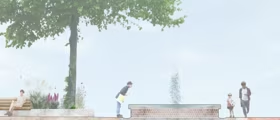
The choice of materials combines regional identity with long-term durability. Fine-format natural stone paving in light to warm gray tones forms the base and is complemented by clinker and water-bound surfaces. Grass joint paving and reinforced turf structure seating and shaded areas. The street furniture concept is based on a continuous system of “Kleve benches,” using the swan emblem as a unifying element. Wooden seating edges on stone supports and smart seating with photovoltaic charging stations expand the offer. The lighting provides both functional base illumination and atmospheric accents at fountains, artworks, and tree plantings – a combination that enhances safety and identity.
Programmatic Spaces Along The Lifeline
City Center Entrances
The entrances to the pedestrian zone are enhanced with distinctive paving patterns, clear lighting, seating, and precise tactile guidance. They form legible gateways to the city center and improve orientation and the arrival experience.
Klosterplatz
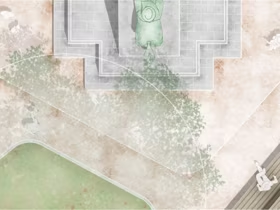
Klosterplatz becomes a green, sheltered urban room where small trees, perennial areas, and retention swales create a pleasant microclimate. Historic elements such as the “Monk” by Johannes Brus are integrated, adding cultural depth to the place.
Cooling Gardens
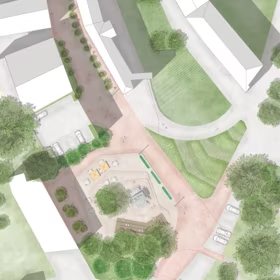
These small retreats form climatic oases within the pedestrian zone. Flowering meadows, species-rich planting areas, and misting nozzles supplied with non-potable water provide cooling on hot days. Colored ground motifs and linear patterns create playful spaces, particularly for children.
Green Spine – Große Straße
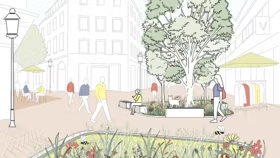
Große Straße becomes the green main axis of the city center. Islands with trees, understory planting, and seating edges rhythmically structure the space. Historic axes and visual connections are made visible in the paving design. Surface water is guided through slot channels and remains perceptible as a designed element.
Elsa Fountain Plaza
The Elsa Fountain receives a newly defined and clearly framed plaza configuration. A grove of trees forms the edge, while a small avenue creates shade and a high quality of stay. The water basin is redesigned more openly while retaining its function and historical significance. Café terraces and flexible seating groups further activate the space.
Dr. Heinz Will Plaza
As the forecourt of the Schwanenburg, the plaza is structurally redefined. Existing trees are preserved and complemented by a seating pyramid. A stepped paving pattern responds to the topography and creates barrier-free access. The forecourt of the historic stable building is also upgraded.
Hagsche Straße
Hagsche Straße is reorganized through blue–green infrastructure. Bioswales, cascading tree plantings, and green strips reduce sealed surfaces and provide shade. Rainwater is stored decentrally, significantly reducing flood risks. Bicycle parking and car parking spaces remain integrated but no longer dominate the space.
Kleve In Transition – An Identity-Forming, Climate-Adapted City Center
The “Lifeline City Center” interweaves Kleve’s history and cultural heritage with the requirements of a climate-resilient future. Water becomes visible as both a design and regulatory element – storage, cooling, and experience at once. Contemporary materiality, ecological innovation, and historic references create a pedestrian zone that will unfold its full impact during the State Garden Show 2029 – and secure a vibrant, resilient, and identity-forming city center for Kleve in the long term.
Image credits
Site Plans, Details, Sections: ensphere
Perspectives: Anne Hina Malette (blue-print Consulting GmbH)